

Nibiru Planet: Searching For The Lost 9th Planet – 2 of 3
Voyage Through Cosmic Secrets: Nibiru Planet, Exoplanets, and Celestial Enigmas
“We are all in the gutter, but some of us are looking at the stars” – Oscar Wilde
Series:Nibiru Planet

🧿✨🛸🎽 Love this artwork? 👉 Get it on t-shirts, mugs, stickers & more here! 🛍️🛒 👕
Content in a Flash – Nibiru Planet:
1. Planet’s Discovery: In this paragraph we will investigate two crucial factors in the general research of exoplanets, including Nibiru;
2. Neptune’s Discovery – Mathematical Predictions and Observations;
3. Pluto’s Discovery: Orbital Irregularities and Observations;
4. Exoplanets: In recent years, mathematicians and astronomers have used mathematical techniques to predict the presence of exoplanets;
5. Pluto’s Intriguing Orbit: Understanding Nibiru’s Potential Influence and the Kuiper Belt’s Mystery;
 ✨ Our Shop Is Here! – When Images Speak Louder Than Words ✨🛸
  👉 T-shirts, mugs,


stickers & more! 🛍️🛒 👕
1. Nibiru Planet and Planet’s Discovery
In the previous paragraph, we outlined a general overview of Nibiru and the issue regarding its actual existence. In this paragraph, instead, we will investigate two crucial factors in the general research of exoplanets, including Nibiru.
1) To prove that mathematically predicting a planet’s existence prior to its observation is common and we therefore are just halfway through the discovery process of Nibiru;
2) The perturbed orbit of Uranus remains nowadays still unexplained with the scientific community chasing the real reason and the only logical explanation is the hidden Planet 9, Nibiru.
Let us therefore briefly review how the other mentioned planets have been discovered mathematically: Neptune, Pluto and various Exoplanets.
Series:Nibiru Planet
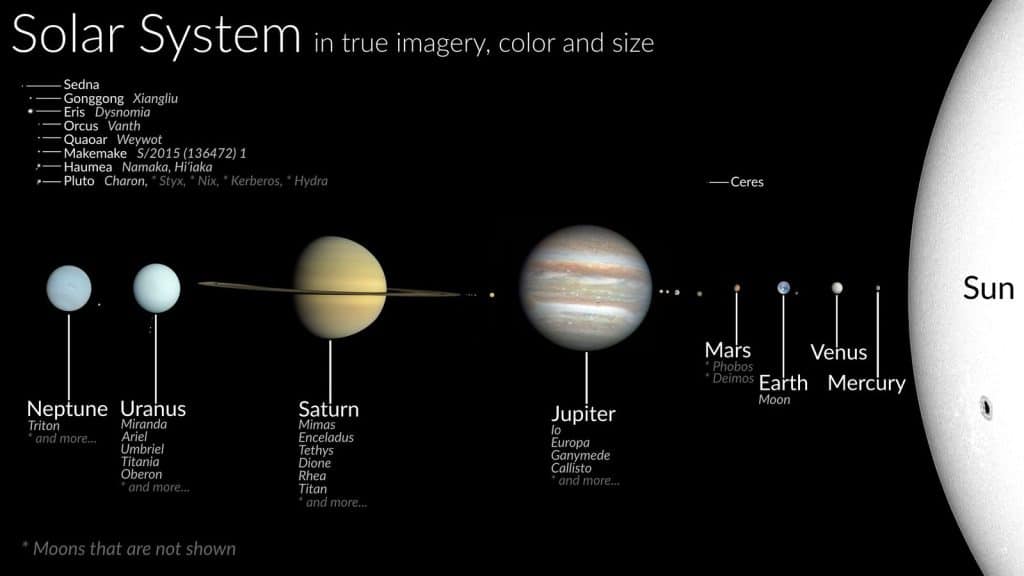
Solar System – Wikipedia, the free encyclopedia
2. Neptune’s Discovery
Neptune was discovered by a combination of mathematical predictions and observational verification. The initial prediction of Neptune’s existence was made by two mathematicians and astronomers, Urbain Le Verrier and John Couch Adams, independently and almost simultaneously in the early 19th century.
Their calculations were based on the observed perturbations in Uranus’ orbit.
Johann Gottfried Galle, a German astronomer at the Berlin Observatory received a letter from Le Verrier describing the predicted location of the new planet. Using this information, Galle and a colleague initiated a search for the planet that very night and discovered Neptune the day after.
The discovery of Neptune was therefore a combination of theoretical predictions and observational confirmation, with Le Verrier and Adams laying the groundwork through their mathematical calculations, and Galle and d’Arrest confirming its existence through direct observations.
It took the collaboration of this scientific group around 30 years from the moment of the mathematical prediction to the actual observation of the Planet.
The funny (to our case) part of the discovery of Neptune is that astronomers were motivated by the bizarre behaviour of Uranus. However, upon discovering Neptune, the scientific community decided that the cause for Uranus’ erratic behaviour laid somewhere else. Another planet had to be responsible. Hence the search for Planet X continued.
Series:Nibiru Planet
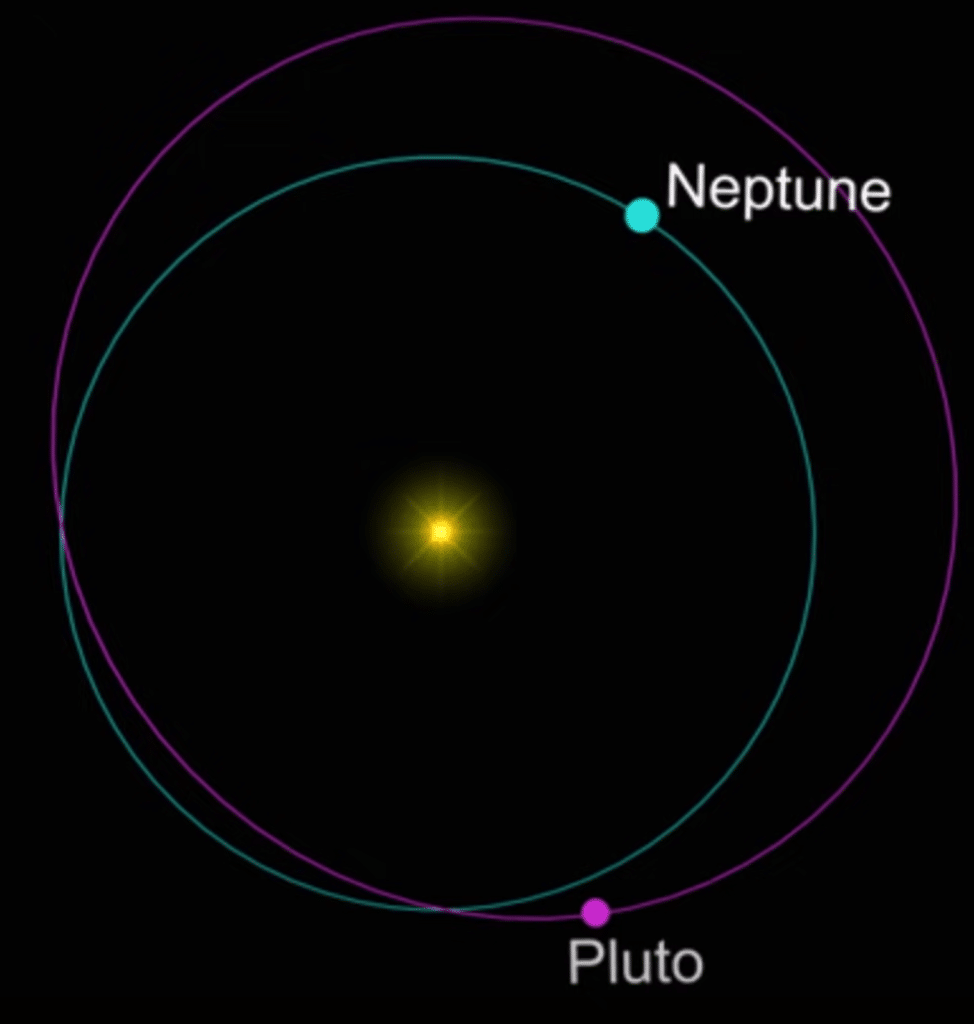
Neptune and Pluto’s orbit
3. Pluto’s Discovery
Another group of individuals picked up the search for Planet X. In fact, the discovery of Pluto was a result of a systematic search for a trans-Neptunian planet that was predicted to exist based on irregularities in the orbit of Uranus. The conviction of Pluto’s existence was based on mathematical analysis.
Percival Lowell was convinced that the movements of Uranus and Neptune were sufficiently aberrant that there was a large planet beyond Neptune and in 1906 he started his observations from the first remote observatory.
Pluto was discovered by an American astronomer named Clyde Tombaugh in 1930. At the time, Clyde Tombaugh was working at the Lowell Observatory in Flagstaff, Arizona. Tombaugh continued the work after joining the observatory after Percival’s death.
Using a device called a blink comparator, Tombaugh compared photographic plates of the night sky taken at different times. By carefully examining pairs of these plates, he was able to identify a moving object in the vicinity of predicted positions. This object turned out to be Pluto.
Most planets travel around the Sun in elliptical orbits, but Pluto deviates from this pattern. Its orbit follows an oval-shaped path, with the Sun not located at its center. Furthermore, Pluto’s orbit is noticeably inclined compared to the other planets, indicating that it does not orbit the Sun on the same plane as the rest of the planets.
What is most interesting in our search for Nibiru from all the above is the following:
1. Pluto cannot be the reason for Uranus’ perturbed orbit, especially since Pluto is so small;
2. The more we move further out at the edge of the known Solar System, the more perturbations we encounter: Pluto’s irregular shape and inclination of its orbit is unique in the Solar System and the existence of a hidden planet beyond Pluto acquires increasing substance;
4. Exoplanets – Nibiru Planet

🧿✨🛸🎽 Love this artwork? 👉 Get it on t-shirts, mugs, stickers & more here! 🛍️🛒 👕
In recent years, mathematicians and astronomers have used mathematical techniques to predict the presence of exoplanets (planets orbiting stars outside our solar system). By analyzing the effects of gravitational forces on the parent star, astronomers can infer the existence of orbiting planets. These predictions are then confirmed through observations using telescopes or space missions.
Many exoplanets have been discovered using these mathematical methods, significantly expanding our understanding of planetary systems beyond our own.
Here are two examples:
– 51 Pegasi b, also known as “Dimidium,” was the first exoplanet discovered around a sun-like star. Its discovery in 1995 by Swiss astronomers Michel Mayor and Didier Queloz was a breakthrough in exoplanet detection. The planet was found using the radial velocity method, which detects the wobbling motion of a star caused by the gravitational pull of an orbiting planet.
– HD 209458 b, nicknamed “Osiris,” was the first exoplanet observed transiting in front of its host star. The discovery was made in 1999 using the transit method, which detects the slight decrease in brightness as a planet passes between its star and Earth.
The discovery of Planet 9, Nibiru, is apparently only a matter of time.
5. Pluto’s Orbit
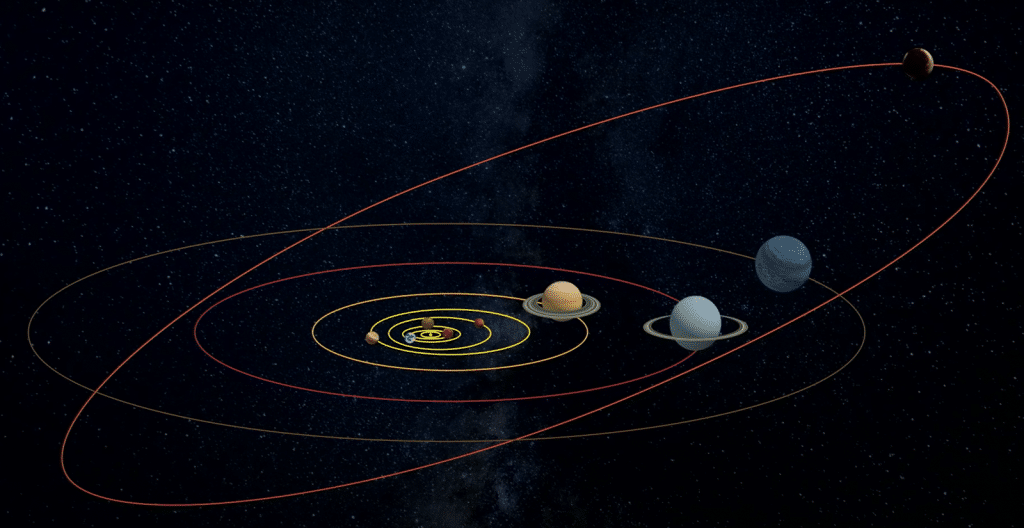
Pluto’s orbit is tilted compared to those of the other planets
Pluto is a dwarf planet that lies in the Kuiper Belt, an area full of icy bodies and other dwarf planets out past Neptune. Pluto is very small, only about half the width of the United States and its biggest moon Charon is about half the size of Pluto.
In the previous chapter we have looked at how Pluto’s orbit has 2 peculiarities: it is oval and it is tilted. But there is more to it. Let’s look at the entire case in detail.
Pluto has an elongated orbit with an eccentricity of 0.25 and unlike what most videos and articles on the Internet state, Pluto’s movement is NOT on the same orbital plane as all other planets in the solar system but rather is tilted 17 degrees. Pluto’s inclination is only partially understood by the scientific community, and this is where several astronomers in history and in current times suggest and strongly believe in the existence of Planet 9 to provide a full explanation.
One reason for Pluto’s tilted orbit is the overlap with Neptune’s orbit.
Pluto is 5,9 billion kilometres away from the sun, with an orbit that takes 248 years to complete. Pluto overlaps Neptune’s orbit and for 20 years out of its 248 years cycle it is closer to the sun than Neptune. Pluto makes 2 revolutions around the sun in the same time that Neptune makes 3.
Neptune’s influence on Pluto is called “celestial resonance” or “vZLK oscillation” and is one known cause for Pluto’s orbit to be both stable and unstable at the same time. More accurately, it is actually chaotic, but this chaos does not go beyond certain limits. It performs each turn in a slightly different way than the previous one.
Series: Nibiru Planet
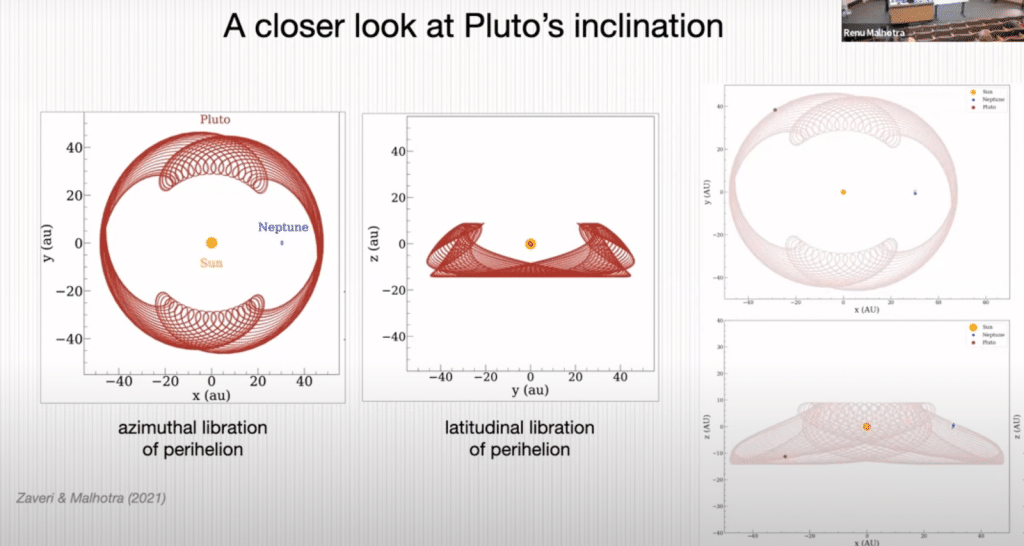
What else is having an impact on Pluto’s bizarre orbit? Clues leading to this answer lie within the Kuiper Belt and beyond. Interactions with other objects in the Kuiper Belt, such as gravitational interactions or close approaches, could influence the eccentricity and inclination of Pluto’s orbit. However several astronomers deem this theory to be too weak given the small size of objects in the Kuiper Belt.
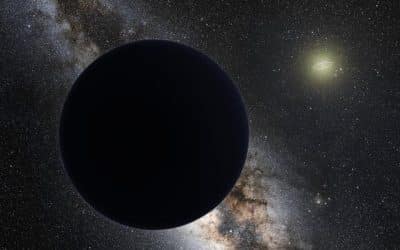
The best and missing explanation for Pluto’s behaviour is the presence of another, much larger planet lingering in the dark and unexplored zone of our Solar System: Nibiru, The Lost 9th Planet.
“Somewhere, something incredible is waiting to be known.” – Carl Sagan


Recent Comments