

The Man, The Legend.
“Ultimately, all moments are really one, therefore now is an eternity.” – David Bohm
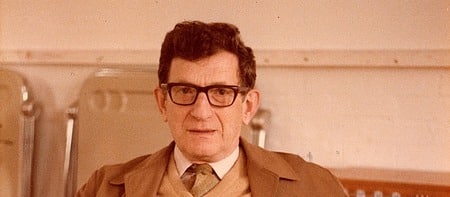
David Bohm – eXtraHuman
Content in a Flash:
1. Who Is David Bohm – The Man: Life, struggles, and groundbreaking ideas of David Bohm;
2. Who Is David Bohm – The Legend: Decoding reality with David Bohm, the legendary physicist who challenged convention and reshaped quantum theory;
 ✨ Our Shop Is Here! – When Images Speak Louder Than Words ✨🛸
  👉 T-shirts, mugs,


stickers & more! 🛍️🛒 👕
1. Who Is David Bohm – The Man
David Bohm was born on December 20, 1917, in Wilkes-Barre, Pennsylvania, United States, and died on October 27, 1992, in London, England.
Coming from an immigrant Jewish family, he is a theoretical physicist mainly known for formulating a causal and non-local interpretation of quantum mechanics.
Despite his father’s desire for him to pursue a practical career in the family furniture business, Bohm persisted in his interest in science and pursued studies in physics.
After graduating in 1939 from Pennsylvania State College, Bohm continued his postgraduate research at the California Institute of Technology and then at the University of California, Berkeley (Ph.D., 1943), where he worked with physicist J. Robert Oppenheimer.
In 1947, he became an assistant professor at Princeton University.
In his post-war articles, Bohm laid the groundwork for modern plasma theory. At Princeton, his lectures were gathered and compiled into an authoritative textbook: “Quantum Theory” (1951), which presented a lucid exposition of Niels Bohr’s Copenhagen interpretation of quantum mechanics.
Serie:Biography David Bohm
However Bohm began to entertain the notion of a causal interpretation of quantum mechanics, diverging from the prevailing Copenhagen perspective—a viewpoint uncommon among physicists of his time. Supported in this by his epistolary discussions with Albert Einstein, Bohm refined his ideas, and developed an interpretation grounded in the concept of unobserved hidden variables.
Sadly, his scholarly pursuits were overshadowed by political turmoil, compelling him to seek refuge abroad. In the midst of the postwar McCarthy era, Bohm’s involvement in left-wing activism during World War II rendered him a suspect.
In 1949, his refusal to testify before the House Un-American Activities Committee on his political affiliations resulted in a charge of contempt of Congress. Despite subsequent acquittal, the fallout was severe: suspension from teaching duties and termination of his position at Princeton in 1951. With the assistance of Einstein, Bohm secured academic positions at the University of São Paulo in Brazil in 1955 and later at the Technion in Haifa, Israel, in 1957.
His academic journey continued in England, where he held positions at the University of Bristol and eventually assumed the role of professor of theoretical physics at Birkbeck College, University of London, until his retirement in 1987.
Efforts to interpret quantum theory changed following Bohm’s work, with a new emphasis on issues of non-locality, non-separability, and entanglement.
Bohm’s subsequent publications became increasingly philosophical; the influence of Marxism gave way first to egalitarianism and then to theosophy through the teachings of Indian mystic Jiddu Krishnamurti, with whom he co-authored “The Ending of Time” in 1985.
Bohm’s most famous book, “Wholeness and the Implicate Order” (1980), also addressed broader issues of human condition and consciousness.
2. Who Is David Bohm – The Legend

David Bohm: Wholeness, Time, Meaning | Beshara Magazine
“I can tell you one thing. David Bohm knows a lot more than just a little about physics.” – Richard Feynman, quoted in F. David Peat, “Infinite Potential: The Life and Times of David Bohm” (1997)
David Bohm stands out as THE scientist who chose to take a serious, deep, comprehensive, and original approach to the question that physicists have been pondering for the past century: the true fabric of our reality, a pursuit that dates back to the inception of modern physics.
He has been a giant of physics; across 48 years of work on physics (starting from his graduation in 1939 until his retirement in 1987) he published 10 books and an uncountable number of academic papers.
After falling victim of the post-war communist witch hunt losing his job as lecturer at Princeton in 1951, he spent his personal and academic life across Brasil, Israel and England. Maybe, this unsettling and mildly nomadic life had an impact on the way he viewed the world, life and quantum mechanics : an out of the box approach where everything is intrinsically, fractally intertwined.
He worked closely and developed personal and professional relationships with Albert Einstein and Robert Oppenheimer early in his career. He became a protégé of both who supported him in his work after his exile. Albert Einstein was notoriously antagonistic to the quantum mechanics theories and yet their relationship was so strong that he encouraged him to pursue the concept of active information that, as we will see later in future articles, will turn into a key component of Bohm’s theory.
A version of quantum theory holds David Bohm’s name: Bohmian mechanics, also known as de Broglie-Bohm theory.

🧿✨🛸🎽 Love this artwork? 👉 Get it on t-shirts, mugs, stickers & more here! 🛍️🛒 👕
David Bohm also cleared the path for Bell’s work and accomplishments by resurrecting the pilot-wave theory which is the backbone of quantum physics: it involves the fundamental concept of matter behaving in a probabilistic manner. The physicist J. S. Bell who not only won the Dirac award but in whose name an award to physicists has been established, commented in these words the work of David Bohm: “David Bohm’s papers of 1952 were for me a revelation” and “Bohm has shown us a way”.
We are no physicists ourselves, but we feel that the work and the views of David Bohm can truly enlighten our path to understanding how we fit in the universe. His caliber as a physicist combined with his comprehensive approach can take any reader beyond just mere equations and thus make him a most appealing physics guru who can answer some of humanity’s burning questions.
Because of this, we have decided to get our hands dirty and in a following series of articles we will bring to light the key points and main conclusions that he had reached in his very last book that he wrote at the summit of his academic life: “The Undivided Universe”.
“David Bohm’s papers of 1952 were for me a revelation and “Bohm has shown us a way. – J. S. Bell


Recent Comments