
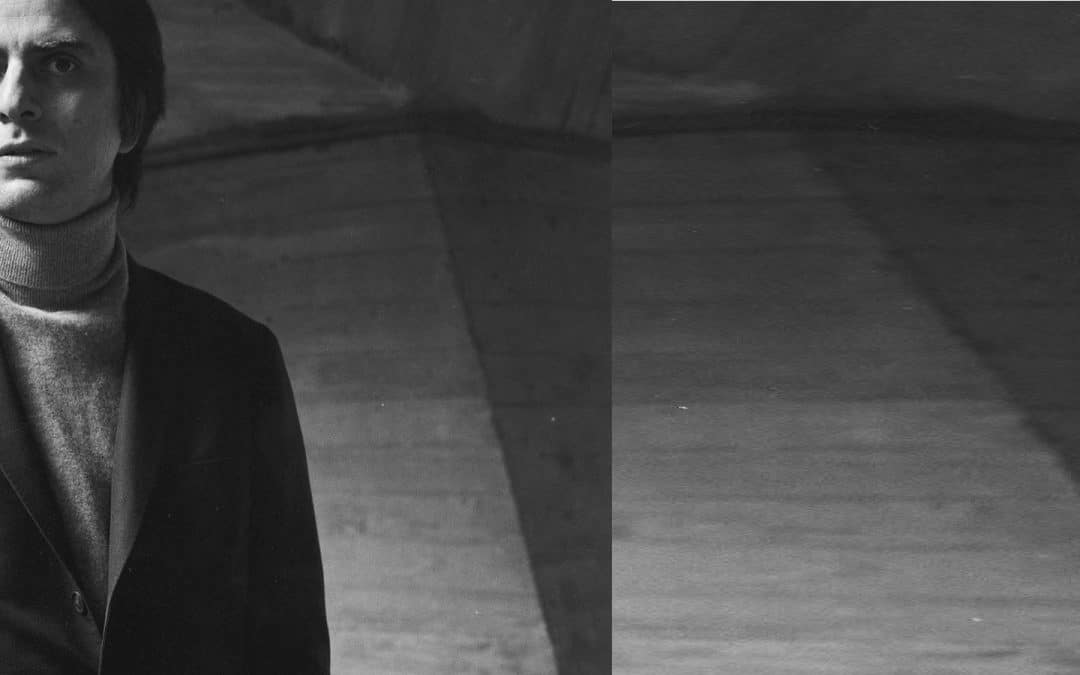

Explore the cosmic insights of Sagan in this captivating interview with Mary Hynes. Discussing the vast universe and the question of a divine designer, this epic conversation aired on Studio 2 on January 30, 1995.
 ✨ Our Shop Is Here! – When Images Speak Louder Than Words ✨🛸
  👉 T-shirts, mugs,


stickers & more! 🛍️🛒 👕
Transcript – Interview: Carl Sagan | Jan 30, 1995 – First Part
In the studio, the host Mary Hynes and her guest are seated, accompanied by a coffee table holding a book.
Mary, a woman in her forties, short blond hair and captivating blue eyes. She is dressed in a satin white shirt overlaid with a floral vest, accessorized with rounded earrings.
The backdrop displays the label ‘Studio 2.’
Mary Hynes:
Carl Sagan is an astronomer who has looked up and wondered ever since he was a child.
He has wanted to visit the planets since then.
Now, he has a vision of our future in space and he explains it in his latest book: “Pale blue dot”.
Professor Carl Sagan joins me now, welcome.
Carl Sagan:
Thank you so much.
Carl, in his fifties, has short brown hair and a clean-shaven appearance. His attire consists of a black suit paired with a light blue shirt and a geometric square green tie. Beneath him is a slate bearing the inscription ‘Carl Sagan. Author of Pale Blue Dot.’
Serie: Carl Sagan Interview
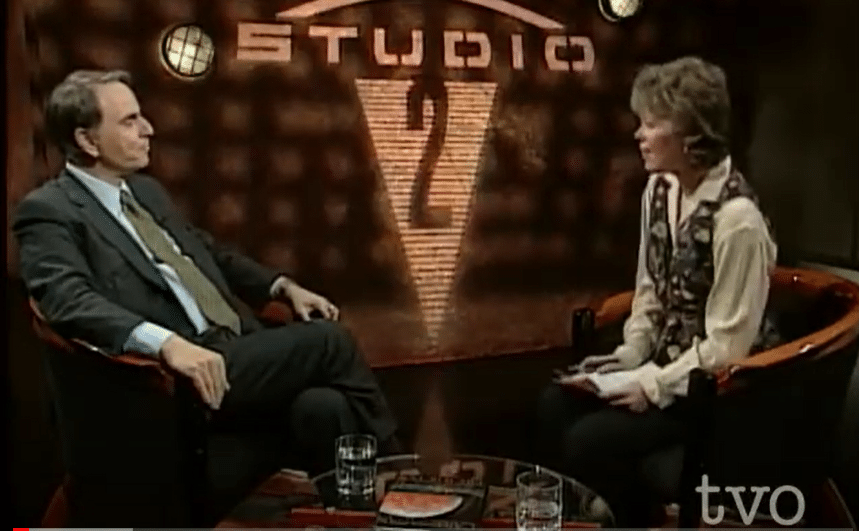
Carl Sagan and Mary Hynes at Studio 2
Mary Hynes:
There are a number of ways of looking at this pale blue dot of ours; some people would see it and be struck by the immensity of the universe, others would see it and be struck by some sort of terrible insignificance of this planet we inhabit.
What do you see when you look at the pale blue dot?
Carl Sagan:
Well, it is true that some people are disappointed that the earth has such a comparatively insignificant role in the universe, but my view is, first of all, it’s not our job to impose our wishes
or fears on the universe.
Our job is to understand what the universe is really like.
Mary Hynes:
There is something very humbling about that picture we’ve just seen though, isn’t there? I mean, does it strike you that way?
Carl Sagan:
Oh, certainly.
I mean, here we are like mites on a plum and the plum is this little planet and it goes around
an insignificant local star, the sun. And that star is on the obscure outskirts of an ordinary galaxy,
the milky way, which contains 400 billion other stars.
And this galaxy is just one of something like 100 billion other galaxies that make up the universe. And it is now beginning to look, this universe is one of an enormous number, maybe even an infinite number, of other closed off universes.
So the idea that we are central, that we are the reason there is a universe is… pathetic.
We have to simply come to grips with the real universe that we really live in and if some of our myth and some of our religion is inconsistent with it, it’s time to change the myth and the religion.
Serie: Carl Sagan Interview
Image Title: ‘Celestial Tapestry Unveiled’ | © Copyright Protected | An AI Digital Art Creation by eXtraHumans to give you a visual glimpse into the extraordinary. Visit eXtraHumans on RedBubble! Your support helps continue this journey, Dive in!
🧿✨🛸🎽 Love this artwork? 👉 Get it on t-shirts, mugs, stickers & more here! 🛍️🛒 👕
Serie: Carl Sagan Interview
Mary Hynes:
You call them the great demotions, all of these thoughts which we have so cherished – well, guess what? The universe doesn’t revolve around the earth and guess what?
The earth isn’t the only world out there.
Are we still clinging to any conceits such as those which led to the great demotions over the past few centuries?
Carl Sagan:
Well, you would think that we should be over it, but we still are battling, at least in the United States, the conceit that humans are separate from the rest of nature; that an unbridgeable
gap separates humans from the other plants and animals, that we are the particular beneficiaries of the concern of the creator of the universe more than any of the 10 million other species of plants and animals on the earth.
When in fact, all of our vaunted uniqueness turns out to be shared with other animals, especially with chimpanzees – our closest relatives, with whom we share 99.6 percent of our hereditary material.
Another area in which the demotion is being fought, is the idea that there are no other planets beyond those in our own solar system. But in the last 15 years, the most marvellous set of findings has occurred in which it now appears that planets are an ordinary, probably inevitable, accompaniment of star formation and that almost every young star, like the sun, in the early stages
of formation, is surrounded by this flat disc of gas and dust out of which the planets were formed.
Reading Suggestion: Exolife On Exoplanets.
We now have the first bona fide real planetary system around a very unlikely object, a particular pulsar called 1257 plus 12, and the technology is just about to reach out and find whatever planetary systems there are nearby.
The third one is the idea that even if there are an enormous number of planets, only ours
has life and intelligence. And there, the story is open.
We send spacecraft to other planets like mars to see if there are any simple forms of life, we use radio telescopes to see if messages are being sent to us by civilizations on planets of other stars.
So far, although there have been some very curious, tantalizing findings in both of those approaches, we have found nothing definitive, unambiguous evidence for extraterrestrial life.
And the debate is still open, in our ignorance, the geocentrists still find hope.
Mary Hynes:
Each of these great demotions over the centuries, when each of our old conceits fall, they’ve all been in some way or another a rebuke to religions – from galileo and the church, and galileo having been proven to be somewhat smarter than the church all the way on down. Yet there are still those in science who say the exquisite nature of the universe, the exquisite laws of the universe, are evidence of a designer, of a creator.
Does that view make sense to you?
Carl Sagan:
It’s very tempting. We want to be thought of as children being cared for by an omnipotent, omniscient, and benevolent creator.
Think of all the uncertainties and turmoil and terrors of our life, which would be made less terrifying if this were true, but here, if anywhere is a case where we must not believe because
we want it to be true.
Serie: Carl Sagan Interview
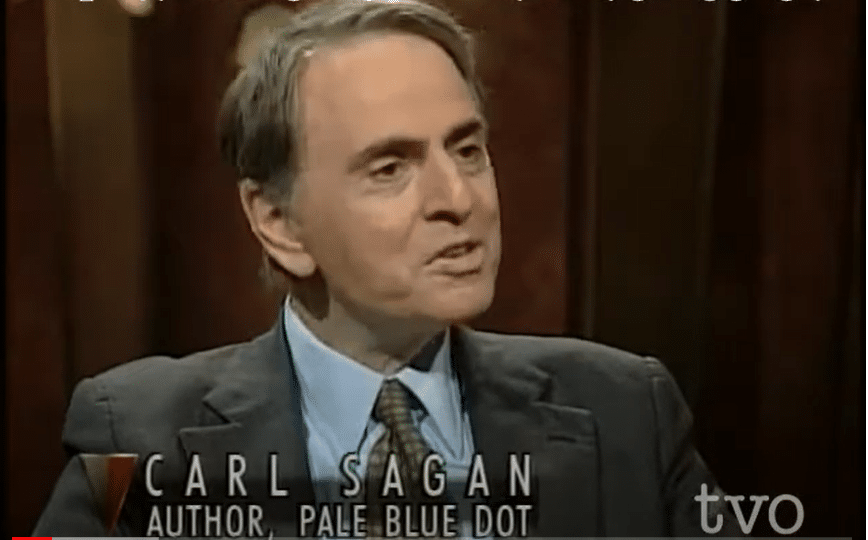
Carl Sagan – 1995
Now, if you take a look at Darwin, you see a case where it was so tempting to say, i find a watch, it requires a watchmaker. Watches do not spontaneously self-assemble.
And now i find an acorn, or a squid, or a bacterium; it is much more intricately and exquisitely put together than a watch – here too there must have been a creator.
It’s very natural.
But what darwin pointed out is that there’s a perfectly reasonable process which is inevitable, which would create enormous exquisite order out of chaos, given enough time. If we thought the universe was only 6,000 years old, there is not enough time and evolution is nonsense.
But if, as in fact is now definitely true, the solar system and the earth are 4.5 billion years old, billion years old, then there’s plenty of time for evolution and our sense that order means creator is wrong.
Finally, you can say look, you can go back as far as you want, but somehow the stuff of the universe had to come from somewhere and isn’t that what god did, but that’s only true if the universe was created.
If the universe was always here, if the universe was infinitely old, then there’s nothing for a creator to do.
Serie: Carl Sagan Interview
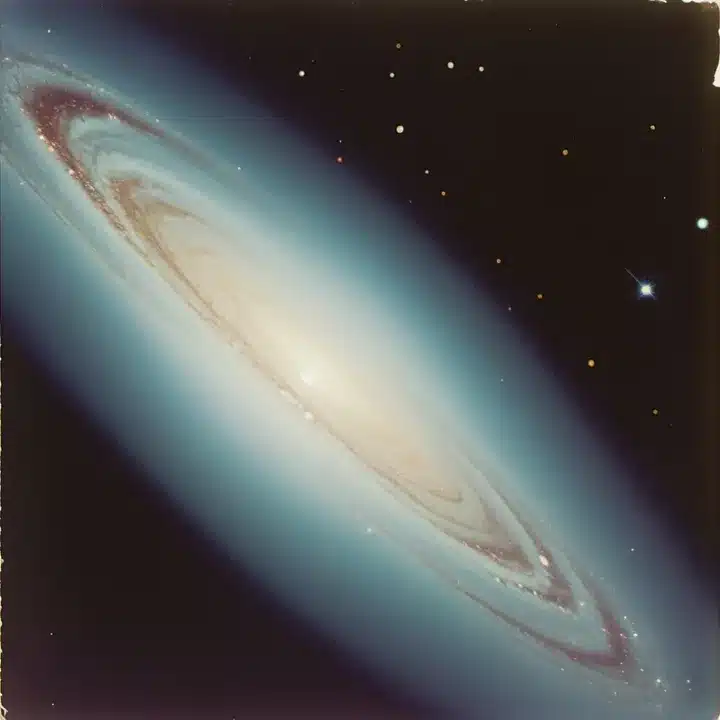
Image Title: ‘Vintage Cosmic Wonders: Retro NASA’s 70s Galactic Photography’ | © Copyright Protected | An AI Digital Art Creation by eXtraHumans to give you a visual glimpse into the extraordinary. Visit eXtraHumans on RedBubble! Your support helps continue this journey, Dive in!
🧿✨🛸🎽 Love this artwork? 👉 Get it on t-shirts, mugs, stickers & more here! 🛍️🛒 👕
Most of us would be surprised to hear that the universe is going to end one day.
We expect the universe to go on forever into the future. Why do we have the idea that it doesn’t go on forever into the past?
I’m not saying i know the answer to this. This is one of the deepest questions we do not know
the answer.
We simply have to keep an open mind – all of us. Philosophers, scientists, religious people.
No one, in fact knows.
Serie: Carl Sagan Interview


Recent Comments